My Website Design Process
From Overwhelmed to Online: How I Turn Your Ideas Into a Website That Works
Building a website can feel overwhelming.
There are colors to choose, words to write, photos to find, pages to organize, platforms to learn, and about a hundred tiny decisions that seem to appear out of nowhere.
And if you're already running a business, the last thing you need is another project that consumes all of your time and energy.
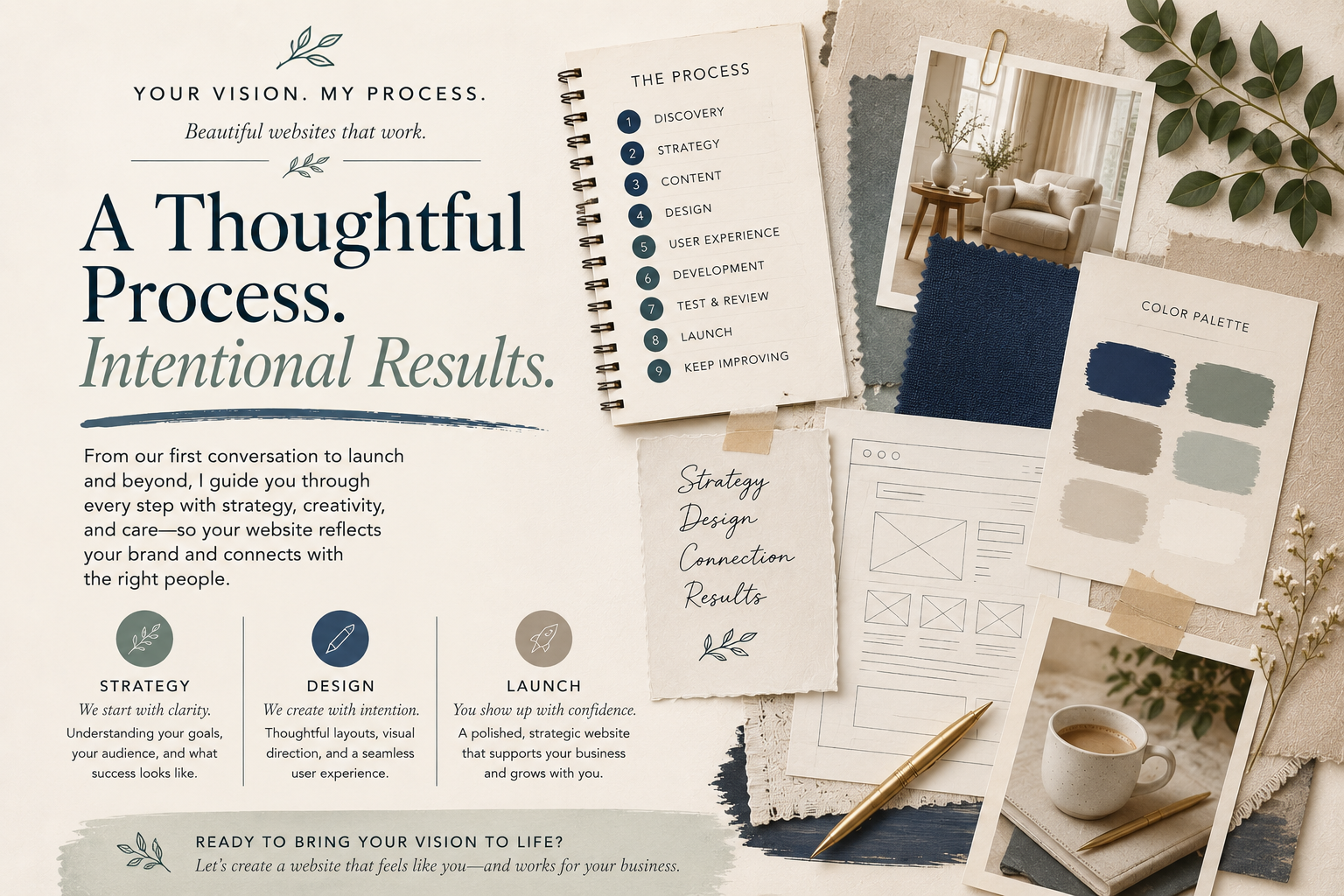
That's where a thoughtful website design process makes a difference.
My job isn't simply to make your website look beautiful.
It's to help you make sense of all those pieces, create a clear strategy, and turn your expertise into an online experience that feels like you—while making it easier for the right people to understand what you offer and take the next step.
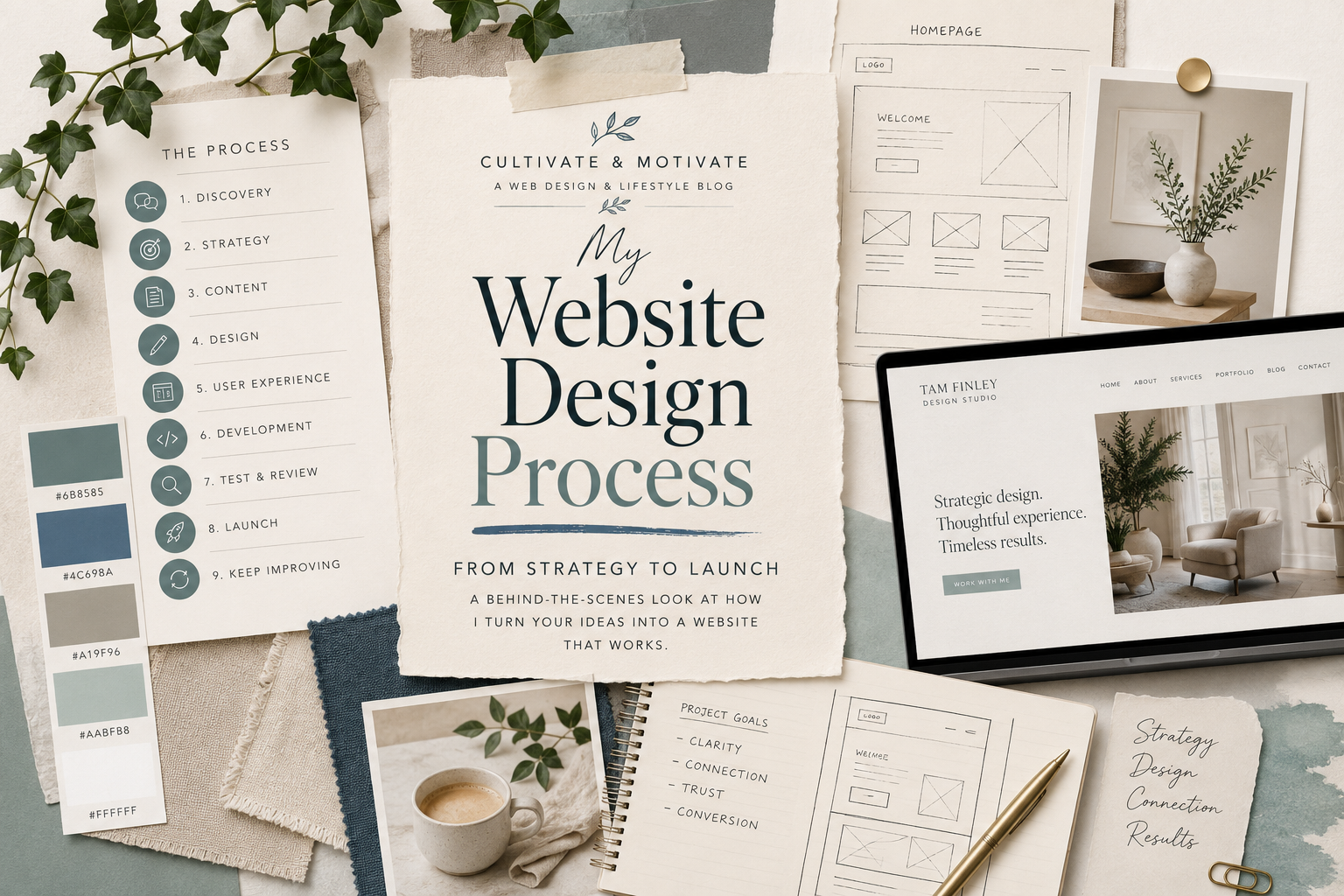
Here's what that process looks like.
1. We Start With a Conversation
Before I think about fonts, colors, layouts, or animations, I want to understand you and your business.
What do you do?
Who do you serve?
What makes your business different?
What isn't working about your current website?
What are you hoping your new website will accomplish?
And perhaps most importantly:
How do you want people to feel when they encounter your brand?
A website can look technically perfect and still feel completely wrong for the person behind the business.
The discovery process helps me understand the person, purpose, and personality behind the project before we start making visual decisions.
Quick Fix
If you're planning a website yourself, don't start with your homepage design.
Start by writing down:
Who you serve
What you offer
What makes you different
What you want visitors to do
What you want visitors to feel
Those answers become the foundation for everything that follows.
2. We Get Clear on Your Strategy
A website needs a job.
Maybe yours needs to generate inquiries.
Maybe you need to establish credibility for a growing business.
Maybe you're launching a new offer.
Maybe your existing website no longer represents the level of business you've become.
Whatever the goal, we need to understand it before we decide what the website should look like.
This is where I look at things like your audience, positioning, content, competitors, services, and customer journey.
We're answering a fundamental question:
What does this website need to accomplish for your business?
Because a beautiful website without a strategy is just a beautiful website.
Quick Fix
Give every important page on your website a purpose.
If you can't answer “Why does this page exist?”, it may be time to reconsider whether you need it.
3. We Organize the Content
This is often the part clients find most overwhelming.
What pages do you need?
What goes on the homepage?
What belongs on your About page?
How should your services be organized?
Where should testimonials appear?
What should visitors see first?
Before designing the visual experience, we need to create a logical structure.
This is where sitemap planning and content organization become incredibly valuable.
The goal isn't to give visitors more information.
It's to give them the right information at the right time.
Quick Fix
Look at your current navigation.
Could someone unfamiliar with your business understand where to go within a few seconds?
If your navigation contains twelve different options, you probably have an opportunity to simplify.
4. We Create the Visual Direction
Now we get to the fun part.
This is where strategy begins translating into visual language.
Typography.
Color.
Photography.
Textures.
Graphic elements.
Spacing.
Layout.
Imagery.
But I don't want the design to simply look good.
I want it to communicate something.
A sophisticated palette might help position a brand differently than a bright, energetic one.
A particular typeface can make a business feel editorial, approachable, traditional, or contemporary.
Photography can establish personality before someone reads a single word.
Every choice contributes to the experience.
Quick Fix
Choose your visual elements as a system rather than individually.
Your colors should work with your typography.
Your photography should work with your colors.
Your graphics should support your brand.
When everything is chosen independently, the website can start feeling visually fragmented.
5. We Design the User Experience
This is one of my favorite parts of the process.
Because great web design isn't only about what visitors see.
It's about what they experience.
Where do they go first?
What information do they encounter?
What questions might they have?
Where should they find reassurance?
What happens when they're ready to work with you?
I think about those moments throughout the design process.
The goal is to create a website that feels intuitive rather than making visitors work to figure it out.
Quick Fix
Choose one primary action for each important page.
Don't make visitors decide between six different things you want them to do.
Give them a clear next step.
6. We Build the Website
Once the strategy and design are established, the pieces come together.
The approved designs become a functioning website.
This is where typography, imagery, navigation, forms, buttons, mobile layouts, and all of those seemingly small details become part of one cohesive experience.
And yes, there are always details.
That's part of the work.
A website isn't finished simply because it looks good on a desktop screen.
It needs to work across devices and screen sizes and provide a consistent experience for your visitors.
Quick Fix
Never approve a website based solely on your desktop computer.
Check it on:
Your phone
A tablet
A laptop
A larger desktop screen
Look for awkward spacing, difficult-to-read text, oversized images, and buttons that are difficult to tap.
7. We Refine, Test & Review
This is where a good website becomes a polished website.
We review the details.
Is the navigation intuitive?
Are the links working?
Are forms functioning?
Are images optimized?
Is the typography consistent?
Does the mobile experience work?
Are calls to action clear?
Does the website feel cohesive from beginning to end?
This stage isn't glamorous, but it's essential.
The last 10 percent of refinement can make a significant difference in how professional the finished website feels.
Quick Fix
Before launching your own website, click every single link.
Submit every form.
Read your pages on your phone.
Check your images.
Then ask someone who doesn't know your business to navigate the site.
You'll catch things you stopped noticing weeks ago.
8. We Launch
Launch day can feel exciting—and a little terrifying.
After all the planning, writing, designing, revising, and testing, it's finally time to put your new website into the world.
But launching isn't the end of the process.
It's the beginning of your website's life as a business tool.
Your visitors will tell you things your design process couldn't.
Analytics will reveal what people are actually doing.
Questions from potential clients may reveal places where your messaging could be clearer.
And your business will continue to evolve.
Your website should be able to evolve with it.
Quick Fix
Don't treat your website like a brochure you publish once and forget.
Schedule a quarterly review of your content, links, services, testimonials, imagery, and calls to action. This is where web maintenance becomes a very valuable service for my clients.
9. We Keep Improving
One of the biggest misconceptions about websites is that there is a magical moment when they're completely "done."
There really isn't.
Your business changes.
Your offers change.
Your clients change.
Your goals change.
Your website should change with them.
Sometimes that means adding a new service page.
Sometimes it means rewriting a headline.
Sometimes it's a complete redesign.
And sometimes the best decision is to leave what's working alone.
That's why I believe good website design should be intentional and adaptable.
What You Can Expect From Working With Me
A website project doesn't have to feel like handing your business over to someone and hoping they understand what you're trying to say.
My approach is collaborative.
I bring strategy, UX thinking, visual design, and technical expertise to the project.
You bring your knowledge of your business, your clients, and your vision.
Together, we turn those pieces into something tangible.
The result isn't just a website that looks like your brand.
It's a website that communicates your brand.
Tam's Perspective
I think the best websites happen when design and strategy are given equal weight.
A website can be beautiful and still be confusing.
It can be functional and still feel forgettable.
It can have all the right information and still fail to connect with the person reading it.
My goal is to find the middle ground:
Beautiful enough to make an impression.
Strategic enough to make a difference.
Intuitive enough to make people want to stay.
That's the kind of website I want to create for every client.
A Website Project Doesn't Have to Feel Overwhelming
If you're staring at your current website wondering where to begin, you don't necessarily need to figure everything out before reaching out.
That's part of what I'm here for.
You don't have to arrive with a finished sitemap, perfect copy, finalized brand palette, and a folder containing 300 perfectly curated photographs.
You can arrive with an idea.
You can arrive with a messy Google Drive.
You can arrive knowing only that your current website isn't working anymore.
We'll start there.
Ready to Build a Website That Feels Like Your Business?
Your website should do more than give people somewhere to find you.
It should communicate your value, build confidence, create a memorable experience, and make it easier for the right clients to take the next step.
If you're ready to stop piecing it together on your own, let's talk about what your website could become.
Explore my web design services and learn how thoughtful strategy, UX, and design can transform your online presence.